

TOC
Table of Contents
Multi-currency in Salesforce allows you to receive payments across the globe in different currencies. This does not mean that the value of the currency will change. It will remain the same, but the conversion rate will come in between to handle the same.
Do you need to do this manually? With challenges persisting? Well no! This blog will help you understand the benefits businesses can realise, the challenges they face with multi-currency payment processing, and the solution to it.
Let’s get started!
Benefits of multi-currency payments for businesses
Let us first look at what you will get by enabling multi-currency in your business!
Increased revenue through access to untapped markets
While your business is present across various locations worldwide, the customer base is automatically spread across them. With multi-currency payment processing support in your business, you can receive payments from various countries and tap into markets that have not yet been tapped. Therefore, international payments indirectly increase the business’s revenue.
Access to diverse income streams
As we have discussed above, with businesses tapping into new markets, it is understandable that this creates various income streams. Your business is no longer reliant on a single market or currency, while open to many.
With this, the risk of fluctuating currency and the downturn of the market is reduced, and you are financially stable.
Improved customer experiences
Let’s understand this point with an example. Think of a situation where a potential customer from a foreign country is purchasing your product. At the time of checkout, he is unable to find a suitable currency option due to the limited currencies supported by your gateway. What do you expect the customer to do? To convert the amount into the currencies you have presented and then make a payment? Well, this is too much of a job for the customer. They might abandon the cart and switch to a competitor. As a result, you will lose revenue.
However, with multi-currency enablement, the customer can choose their preferred currency. Therefore, the customer experience is enhanced if you value what the customer is actually looking for.
Multicurrency challenges in Salesforce
We have discussed a few challenges that businesses might face related to multi-currency.
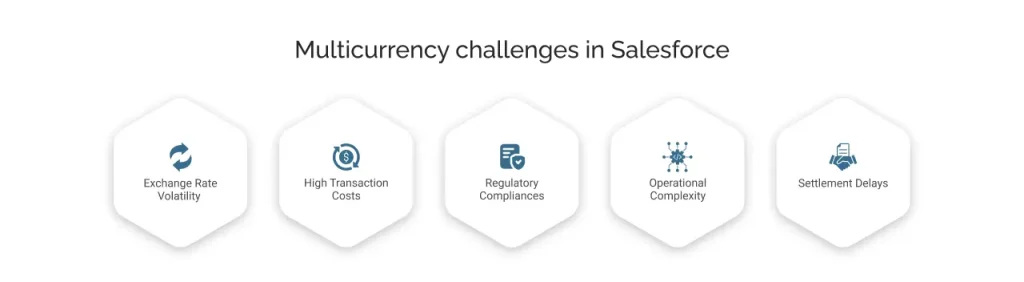
Exchange rate volatility
The fluctuating currency value can lead to financial losses if the payments are not timed or mapped correctly. This can erode your profitability margins and create a challenge for the financial teams.
High transaction costs
When setting up manually, the currency conversion rates incur multiple fees from banks and intermediaries that also add up. This increases the cost and reduces your profit margins.
Moreover, cross-border payments add extra charges without efficient management platforms.
Regulatory compliances
It requires adherence to different compliance across the globe. You have to take care of the tax reporting, AML, and VAT rules, risking penalties without proper tools.
Operational complexity
Manually tracking multiple currencies, reconciling accounts, and managing bank relationships can overwhelm your business teams and increase operational complexity. Additionally, refunds, partial payments and incomplete transactions can extend the month-end closing and financial mapping, resulting in delays.
Settlement delays
Multi-currency payment processing and cross-border transactions take days to complete. This is due to the intermediaries and time zones that tie up cash.
How ChargeOn solves multi-currency payment processing challenges in Salesforce?
We have got you a solution that helps you resolve all the above challenges: ChargeOn, a Salesforce payment processor and orchestration solution.
Currency conversion and exchange rate management
Salesforce payment processor like ChargeOn helps you with currency conversion in real-time. It helps in converting the currency automatically to your (merchant’s) preferred currency when a customer is making a purchase. This allows for seamless management of exchange rates.
Additionally, it offers Dynamic Currency Conversion (DCC) options during checkout. It allows your customers to see and pay in their currency at the point of sale, with the exchange rate displayed clearly.
Security measures
When transacting money online, be it in any country, spammers are always looking for that one golden chance to steal your money. To avoid this money theft, payment processors guarantee secure and reliable transaction processing. Also, a well-designed payment architecture improves the overall payment gateway experience in Salesforce.
They follow strict security standards like encryption, tokenization and multi-factor authentication.
Let’s see how these techniques eliminate unauthorized access to the transaction data.
Encryption converts the data into a code that can only be decoded by a unique key. This prevents the unauthorized user from looking into the transaction data and misusing it.
On the other hand, tokenization replaces the transaction information with a unique and random set of characters called tokens. This process helps the user to keep the data safe, as the original data is not being used or stored anywhere. Even if anyone gets unauthorized access to tokens, they wouldn’t be able to make a fraudulent transaction.
Multi-factor Authentication enhances security by requiring users to go through multiple verification steps during login. This added layer of protection makes it more challenging for hackers to compromise transaction data.
Compliance with international regulations
Payment processors ensure compliance with international financial regulations. These are designed to prevent money laundering, terrorist financing, tax evasion and other financial crimes. Let’s dig deeper into some of the compliance followed by the top payment processor.
Anti-money laundering
It is a set of policies, procedures and technologies that prevents criminals from exchanging the black money they earned through illegal practices for legitimate or clean money.
Know Your Customer (KYC)
It helps verify the identity and legitimacy of the user, its sources, and the destination of funds through their governmental documents.
Cross-border transactions
When it comes to processing cross-border payments, payment processors adhere to various regulations and laws set by different jurisdictions. These rules include the guidelines provided by the Financial Action Task Force (FATF), the Foreign Account Tax Compliance Act (FATCA), and the Common Reporting Standards (CRS).
These regulations help ensure that cross-border payments are transparent, secure, and in compliance with international standards.
Automated record keeping in Salesforce
Manually updating every transaction record and details in Salesforce? Very time-consuming and effort-intensive. However, a payment processor offering automated workflows that synchronise the transaction data and store it in Salesforce saves you time and reduces the risk of errors. This becomes even more valuable when you’re accepting payments directly inside Salesforce.
It allows you to create sub-categories based on countries, currencies, customers, etc. and adds up the new records based on these criteria. Additionally, you can extract data and gain insights whenever needed through charts and graphs.
All these capabilities of a payment processor make it an efficient option for receiving and managing international and multi-currency Salesforce payments.
Salesforce multi-currency considerations
Here are a few important aspects to consider:
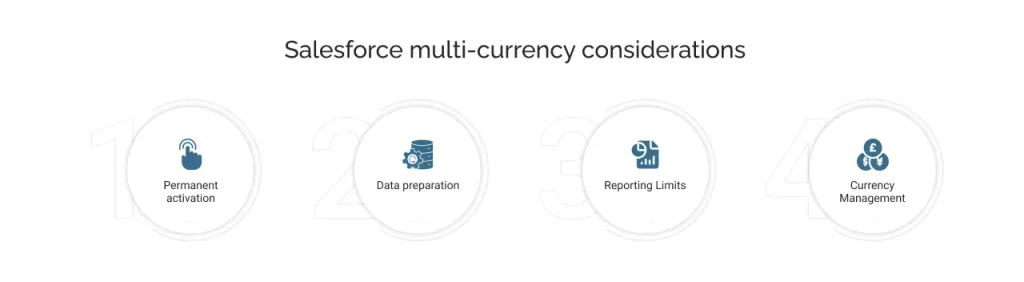
Permanent activation
You can’t disable multiple currencies once enabled.
Data preparation
You must convert all existing records to one default currency before enabling, or use Salesforce’s paid service for help.
Reporting limits
Field-to-field filters in reports won’t work with currency fields like Amount after enablement.
Currency management
Added currencies can’t be deleted from the admin list, even if deactivated. They remain visible to admins but not users.
Top platforms for multi-currency merchant payment processing 2026
Here is a list of the top platforms/applications that help you with multi-currency payment processing.
1. ChargeOn
A Salesforce native payment processor and orchestration platform that supports zero-decimal, two-decimal, and three-decimal currencies. This ensures compatibility with regional financial standards.
- It allows business users to set default currency preferences based on their operational needs.
- It supports processing transactions in customer-specific currencies.
- It automatically adapts to currency formatting rules (zero, two, or three decimals).
- It works seamlessly across different payment types and methods.
2. Chargent
Chargent processes payments in multiple currencies via integrated gateways, with three control levels:
- Org default currency in settings
- Record-specific currencies (e.g., on Orders)
- User-selected options in consoles or requests.
3. Findock
FinDock leverages Salesforce multi-currency (CurrencyISOCode on payment objects like Installment), handling it automatically for one-time/recurring payments, reconciliation, and validation against org/user defaults or payment methods.
4. Fonteva
Fonteva requires Salesforce multi-currency activation first, then enables a “Fonteva Multi-Currency Critical Update” for full support, including customer selection in the Community Portal.
Summing up
The challenges discussed above have a feasible solution: ChargeOn. This payment processor and an orchestration solution enable multi-currency in Salesforce, resolves the certain challenges, but also come with additional features that help you streamline your multi-currency receivable process.