

TOC
Table of Contents
Your business teams spend a significant amount of time every month creating invoices, updating amounts, reminding customers of their recurring payments, and chasing payments, all manually. This approach is prone to errors, leading to delays, corrections, and sometimes lost revenue.
For instance, a small error, like billing $40 instead of $400, can silently repeat every month. You can see the clear difference in how this can affect the business revenue. Not just this, but the manual approach can increase your involuntary churn, increase management complexity as you grow, and make it difficult to map out mistakes in your financial books.
In order to eliminate or reduce these challenges, you must incorporate automation in Salesforce and ensure its optimality.
How will this benefit your business? How will it affect your business revenue and growth? How will it affect your business teams? In this blog, we will explore the answers to these questions as well as delve into additional queries you may have.
Hence, let’s get started with the basics!
What is Recurring Billing?
Recurring Billing is a process where businesses bill their clients on a specific date, at regular intervals, or over a fixed duration. This duration can vary from month to month, quarterly, annually, or on any other basis that the business desires.
When clients decide to subscribe to a business’s product or service, they agree to pay a fixed charge for a distinct period. When the chosen period is over, customers can either renew their subscription with the same plan or select an alternative plan. Despite this, if they don’t want to continue, they are free to cancel their automated subscription at any time they want.
This model is highly recommended for companies that offer SaaS (Software as a Service) products, streaming services, and membership-based offerings, including electricity bills, gym memberships, phone bills, magazine subscriptions, and more.
What is automated recurring billing?
Automated recurring billing is when the manual processes that your business teams were doing are automated. Simply, your system automatically charges customers on a set schedule (monthly, quarterly, etc.) without manual invoicing or chasing payments each time.
Instead of your business team creating multiple invoices manually, fixing typos, emailing customers, and following up on late payments, the system does it all.
Explore automated
Within Salesforce, it pulls customer details, pricing, and subscription information already in your Salesforce records, generates invoices automatically based on billing rules you set, handles failed payments with smart retries, and updates all records in real-time.
The same automation principles also help nonprofit organizations manage recurring donations, donor records, and payment recovery more efficiently. Read about the top donation challenges nonprofits face in Salesforce.
However, you would need to either set up flows in Salesforce or just integrate automated payment management software with Salesforce. ChargeOn is one such automatic payment software and a Salesforce-native application that offers auto-recurring billing features and capabilities.
You must learn the difference between Salesforce billing and Salesforce invoicing to understand Salesforce recurring billing better.
Benefits of Salesforce recurring payment optimization
Let’s explore the benefits that businesses get from recurring billing processes in Salesforce:
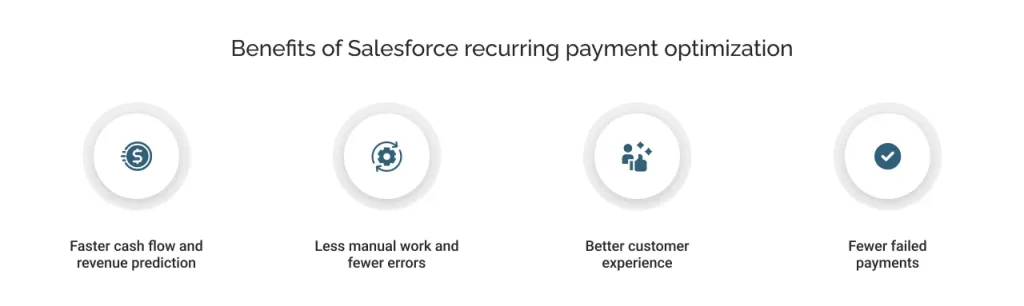
1. Faster cash flow and revenue prediction
As customers sign up for a subscription method, they agree to pay a certain amount for a fixed interval of time. The invoices and charges run automatically as scheduled, be it monthly, quarterly, or annually. Hence, the money comes in regular intervals, making revenue forecasts possible and accurate. It supports your budgeting and financial planning.
2. Less manual work and fewer errors
With automation, your business teams no longer have to map data across different systems manually. This reduces the chances of errors and ensures accuracy and synchronization of data across businesses. It saves your team’s time, allowing them to focus on tasks of greater importance.
3. Better customer experience
Your customers get accurate and on-time invoices. They are charged automatically through their preferred payment method that they have initially set up. Automation makes it easy for customers to continue using the services.
While the add-ons and automated subscription billing options improve customer satisfaction.
4. Fewer failed payments
Automated flows can retry failed payments and send reminders with payment links to customers for the upcoming payment. It is helpful in case the customer wants to modify the payment setup.
It reduces revenue loss due to expired cards and insufficient balance criteria.
Want to know what additional features can help you minimize failed payments? The answer is an integration with a payment processor and orchestration tool. One such application is ChargeOn. It offers a payment retry mechanism and gateway fallback features to ensure payment fulfillment.
Let us understand with an example.
Transforming the fitness industry with an automated recurring billing system
People today are prioritizing their health and fitness, which is bringing a boom in the fitness industry. Majorly, gyms and fitness boutiques are the top players in this market. However, with this growth, their challenges have increased due to their dependency on manual pricing, invoicing, and revenue management processes.
Thus, to manage these processes, an automated recurring billing system is the ultimate solution. By automating the delivery of membership costs, potential customers can easily access the pricing information and receive personalized quotes.
Moreover, the system can automatically calculate the charges based on the membership and add-on activities customers have opted for. Along with this, the recurring billing system helped the business to generate accurate and timely invoices based on the billing cycle opted by the customers.
A centralized view of all the recurring revenue processes results in efficient handling of its revenue collection and predicting future revenue.
While people also demand additional services. To manage the billing of these additional services, the business defined the pricing rules, which were further seamlessly integrated into the billing process. Also, the business was able to measure its financial aspects over different key metrics. This helped them to gain valuable insights into their business performance and make data-driven decisions to sustain and grow.
This example portrays how the automated recurring billing system helps industries overcome the manual billing process.
How to optimize automation for Salesforce recurring payments?
You can optimize automation by consistently improving and maintaining the custom automation flows in Salesforce. However, it requires technical know-how.
Or, you can simply integrate ChargeOn into your Salesforce and get various automated flows. Whether it’s payment collection, done instantly or on a scheduled basis, one-time or recurring, and more.