
How does ChargeOn complement Adyen Salesforce native integration?
ChargeOn offers additional features, an automated workflow set up unique to your business needs, and extended capabilities that help you manage your payments in a streamlined manner.
- In case the primary payment gateway fails, ChargeOn switches to a secondary payment gateway that acts as a backup. This ensures continuous uptime if the primary service faces an outage.
- ChargeOn offers ‘smart’ retry schedules for failed payments, so your transaction is not marked as declined or failed by default.
- ChargeOn enables you to send a payment link through email to your customers in case of failed payments.
- ChargeOn consolidates all your global transactions in one place, providing a "Single Source of Truth" across your entire multi-gateway stack.
- With ChargeOn, you can extend your payment capabilities beyond the storefront. It helps you manage the recurring billing directly from core objects like Opportunities, Accounts, and other objects in Salesforce.
- You can ensure control over your scheduled and recurring payments using ChargeOn.
ChargeOn is a 100% Salesforce native payment processor and orchestration tool. It offers a centralized view of all your payments in Salesforce, bringing data from Adyen and Salesforce together.
ChargeOn provides prebuilt flows for one-time and recurring payments, reminders, retries, and payment links. Additionally, it offers tokenization, PCI DSS-compliant processing, and secure data flows with a failover backup mechanism.
Step-by-step Adyen Integration with Salesforce using ChargeOn
This guide helps you in:
- Assigning appropriate permissions to relevant users
- Configure and set up ChargeOn
Note: Screenshots and details may differ based on your gateway version.
Access to an active Adyen payment gateway account
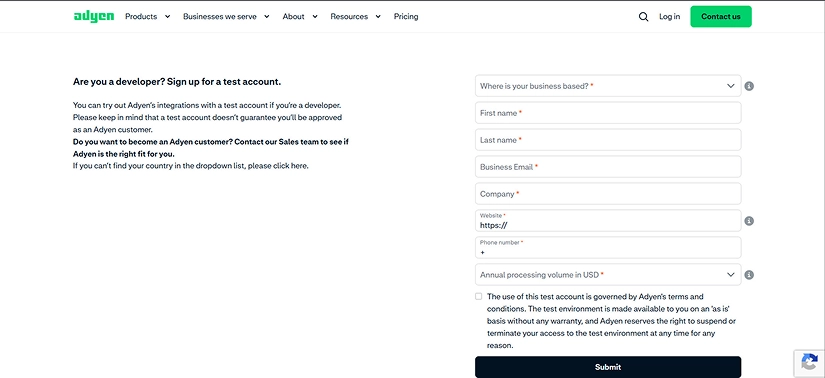
- Go to Adyen
- Create the account by clicking on this link
- Fill in all the details
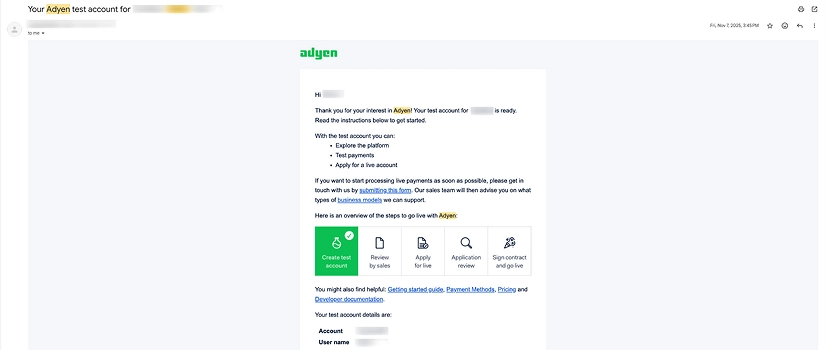
- Verify through the confirmation email received at the registered email address
- You will receive your account details, username, and password at your registered email address
- Reset the password from the link provided in the email
- Login into Adyen dashboard (test for sandbox, live for Live environment)
Technical steps start here:
Step 1. Log in to the Portal
- Go to the Adyen Sandbox login page
- Sign in using your sandbox merchant credentials
Step 2. Open Developers Section
- From the developer section
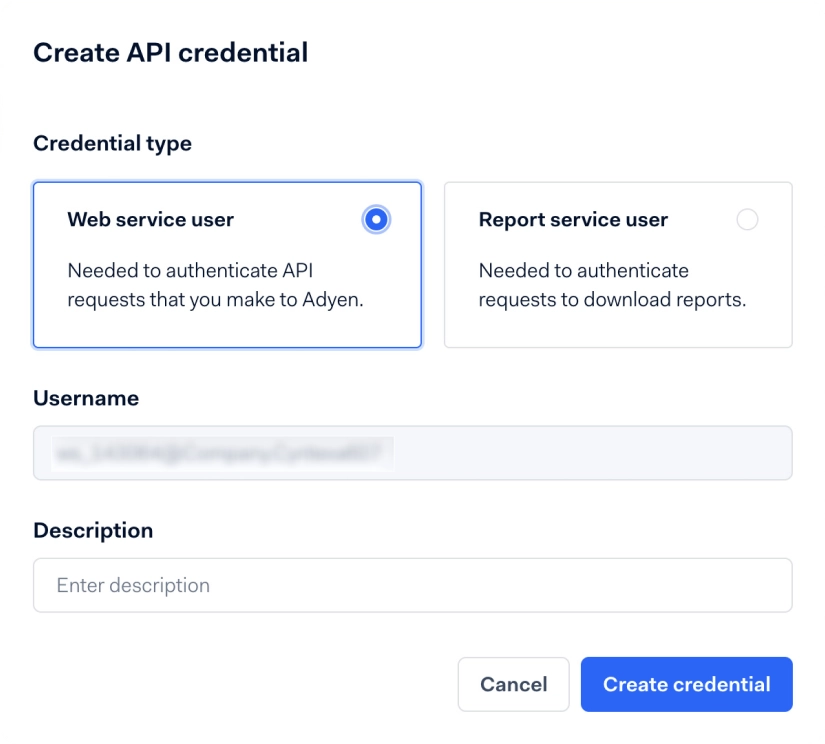
- Click on API credentials
- Click on Create new credentials using web service user
Step 3. Get the Secret Key
- After creating the credentials:
- Copy the API key from the Server settings -> Authentication section
- Save Changes
Step 4. Save and Share Securely
- By now, you have obtained the Secret Key
Create your Adyen payment gateway record in Salesforce
- Click on the App Launcher (9-dot icon)
- Search for ChargeOn.
- Click to open the ChargeOn application.
- From the ChargeOn app navigation bar, open the Payment Gateway tab.
- Click New to create a new Payment Gateway record.

- In Select Gateway, choose Adyen from the dropdown.
- Under Select Payment Method, move the following options from Available to Selected:
- Instant
- Schedule
- Recurring
These define how payments can be processed using this gateway.
- Under Select Payment Types, move the following options from Available to Selected:
- Adyen
This enables payment links for Adyen.
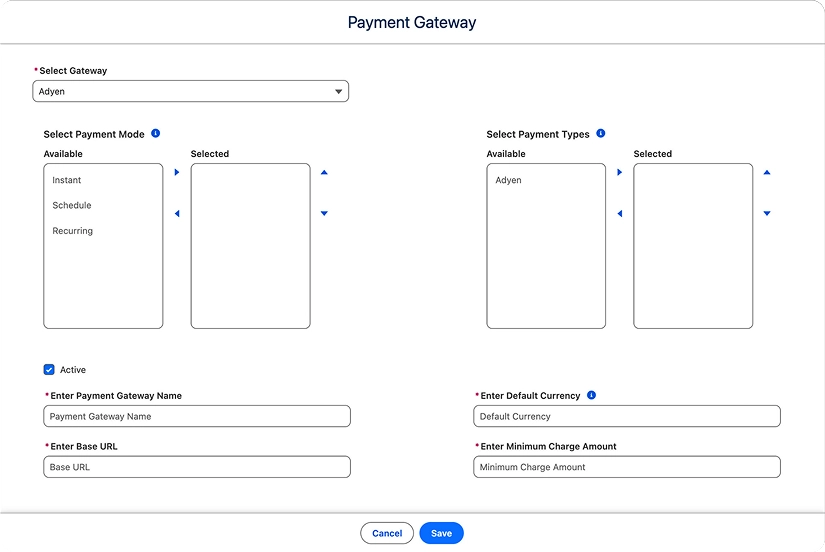
- Fill in the required fields as follows:
- Payment Gateway Name
- Gateway
- Default Currency: USD
- The supported currencies: Refer to this document
- Base URI: https://checkout-test.adyen.com/v71
- Minimum Charge: $1
- Use the apitest URL for sandbox/testing.
- Replace with the production URL when configuring live payments.
Step 7: Add gateway credentials
- In the Gateway Credentials section, add the following key-value pairs:
- Credential
- Key: x-api-key
- Value: {your x-api-key}
- Credential
Step 8: Review all details carefully and click Save
The Adyen Gateway is now configured and ready for use in ChargeOn.
Test your transactions in a Salesforce Sandbox
You can test your integration in multiple ways.
We are sharing one of the simplest ways to test the same using Adyen payments.
Adyen Payment allows you to make payments using a payment link via Credit card or using a bank account number.
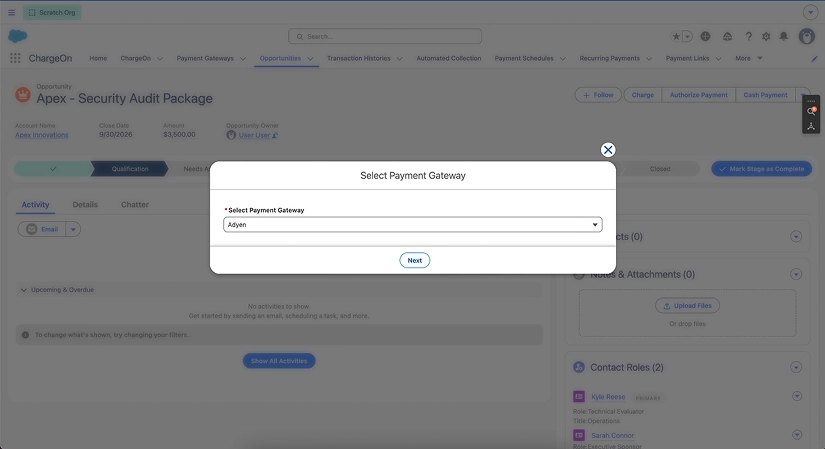
- Selects the payment gateway to start the payment process.
- Once the gateway is chosen, select Adyen Payment as the payment method.
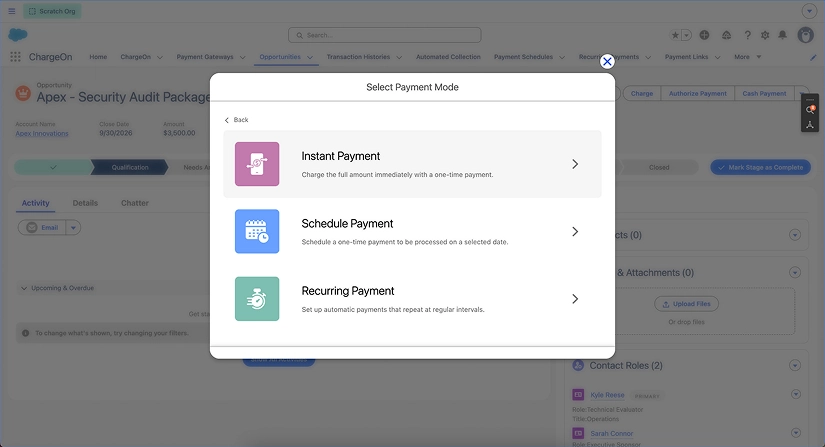
- Choose the payment mode: instant, schedule, or recurring payment.
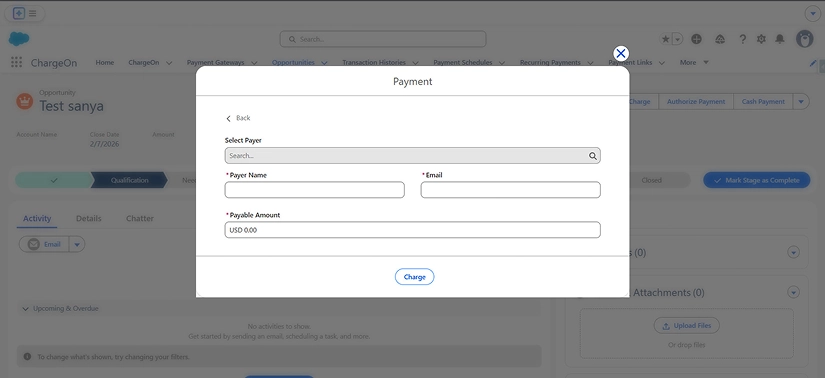
- Enter basic personal details, such as Payee Name, Email, and Payable Amount.
- Click the Charge button to submit the payment.
Prepare to go live in production
After the testing is completed in the Sandbox, the configuration can be migrated to the production environment.
- Refer to this document
- Go to the live Adyen environment and get the credentials with the same steps we
mentioned above. For example:
-
Credential 1
- Key: x-api-key
- Value: {your x-api-key}
-
Credential 1
- Add these credentials to ChargeOn, and now your data is ready for the live environment.
Post deployment, perform controlled production testing to validate end-to-end payment processing before enabling the solution for live users.
With this, your Adyen Salesforce integration is successful using ChargeOn.

Refer to our Salesforce Multi-Gateway Setup Guide for integrating multiple payment gateways and optimizing your Salesforce payment integration. This eliminates the dependency on a single vendor.
Apart from the Adyen payment gateway, ChargeOn supports other widely used global payment gateways, including: