

TOC
Table of Contents
Healthcare organizations rely on Salesforce for a reason. It centralizes patient data, streamlines care coordination, and gives revenue cycle teams a single source of truth to work from.
However, more often than not, we see that the moment we submit a claim or a patient balance is due, a different story begins. Denials accumulate, and payments collected through manual processes are not recorded in Salesforce in real-time. This results in a loss of recoverable revenue every month.
Therefore, this is where most healthcare organizations using Salesforce and healthcare revenue cycle tools encounter a challenge, as they struggle to handle the overall payment processing.
Let’s explore the gaps that are entailed in Salesforce costing healthcare organizations revenue.
Top 5 payment processing gaps that healthcare organizations face
Most revenue leakage in healthcare does not stem from a single major failure. It comes from a handful of recurring gaps in how payments are captured, tracked, and followed up on.
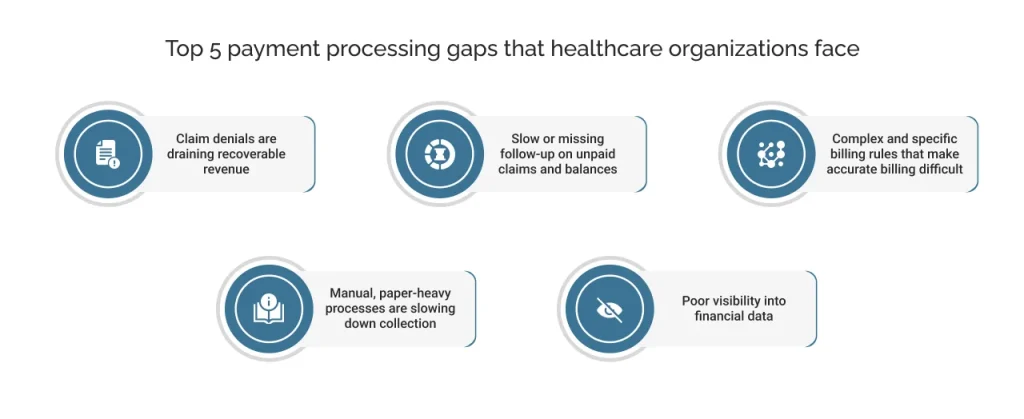
Here are the 5 that most consistently affect healthcare organizations.
1. Claim denials are draining recoverable revenue.
When an insurer (insurance company) denies a claim, the healthcare organization does not just lose that payment, it loses the time. It was the time that staff spent in preparing the claim, investigating the denial, and preparing for resubmission. All these efforts were possibly wasted for a payment that may never come through.
Many organizations simply do not have the bandwidth to fight every denial, so a meaningful share of denied claims is never resubmitted at all. That revenue is not delayed, it is revoked completely. Even when teams do appeal, the resolution process takes the billing staff’s focus away from new claims, creating a backlog that increases the problem.
As per Experian Health, 41% of healthcare providers report that their claims are being denied 10% of the time.
2. Slow or missing follow-up on unpaid claims and balances
Without a system that automatically flags overdue balances and takes the next action, follow-up depends entirely on staff members. However, when your staff is occupied, the follow-up process might suffer. This might increase the risk of the balance getting unaddressed, affecting your revenue.
According to J.P. Morgan, 71% of providers report that it now takes over 30 days to collect payment after a patient encounter, without automated systems that reduce the chances of bill payment.
3. Complex and specific billing rules that make accurate billing difficult
Every payer or insurance company has its own rules for what counts as a clean claim, and those rules rarely match each other.
For example, in one process, the insurer wants a specific modifier code, while in another, it requires prior authorization documentation attached in a certain way. Also, sometimes they have their own definition of medical necessity entirely.
Therefore, billing teams end up tracking dozens of payer-specific requirements across scattered reference sheets, and a single missed detail is enough to trigger a denial.
The problem compounds as payers update their rules throughout the year, often with little notice, leaving billing staff to realize the change only after a batch of claims has already been rejected for it.
A large share of denials trace back to this administrative mismatch rather than genuine concerns about the care delivered.
4. Manual, paper-heavy processes are slowing down collection
Even where the billing itself is correct, the way payments get collected is often manual. Many healthcare organizations still rely on paper statements, mailed invoices, and manual data entry to record what has been paid and what is still outstanding. According to JP Morgan reports, 71% of providers still rely primarily on paper and manual processes for payment collection.
Every one of those steps adds days to the collection cycle and creates chances for human errors. The error can be a misapplied payment, a balance that never gets updated, or a statement that goes to the wrong address.
Patients, for their part, increasingly expect to pay digitally and instantly. A clunky paper-based process not only frustrates the provider but also the patient. This friction and inconvenience might reduce the chances of them making a transaction, impacting revenue.
5. Poor visibility into financial data
When payment data lives outside Salesforce, in a separate billing system, a payment gateway dashboard, or a spreadsheet someone updates manually, then analyzing the data becomes difficult. Therefore, finance and revenue cycle teams are always working with incomplete data.
They cannot tell at a glance which claims are paid, which are overdue, or which gateway a transaction even went through. This is because the information was never connected to the patient or claim record in the first place.
Reports take longer to build because someone has to manually pull and reconcile data from multiple sources before any analysis can begin. By the time a decision-maker sees a revenue report, the numbers have become outdated, making it hard for them to identify the problem.
Each of these gaps may look like a minor operational friction. However, together, they add up to a financial impact most healthcare organizations underestimate.
The numbers behind the revenue loss
These numbers are not abstract industry trends. They translate directly into cash that your organization has already earned but cannot access.
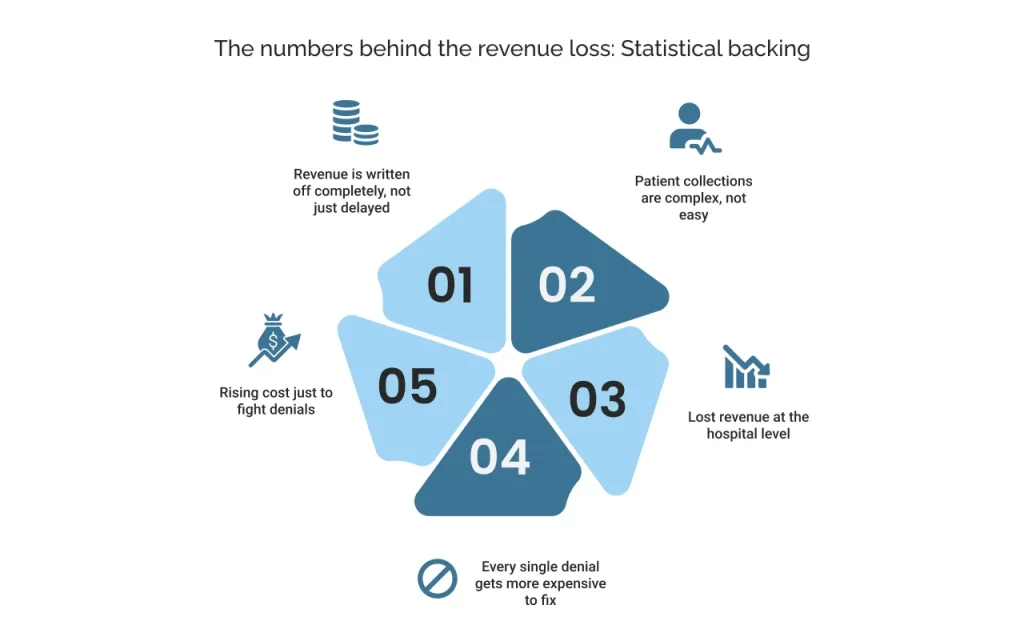
Revenue is written off completely, not just delayed
A significant share of denied claims, an estimated 65%, is never resubmitted at all. That money is not late. It is gone. (Source: HMFA Organization)
Patient collections are complex, not easy
Commercially insured patient collection rates dropped as low as 34.4% in 2025, and collection on balances over $7,500 can fall as low as 17%. (Source: Human Medical Billing)
Rising cost just to fight denials
In 2025, hospitals spent nearly $18 billion overturning claim denials, and the American Hospital Association estimates total spending of $43 billion trying to collect payments insurers already owe for care delivered. (Source: American Hospital Association)
Lost revenue at the hospital level
Hospitals lost $48.4 billion in 2025 to claim denials and bad debt combined, a 25% jump from 2024. (Source: Kodiak Reports)
Every single denial gets more expensive to fix
The administrative cost of working one denial rose from $43.84 in 2022 to $57.23 in 2023, and some leaders say this still understates the real cost. (Source: IMO Health)
These numbers make one thing clear: the gap is not a lack of effort from billing teams. It is a lack of systems built to close it automatically.
How can a healthcare organization cover these payment processing gaps inside Salesforce?
Salesforce for healthcare gives organizations a strong foundation for managing patients and revenue cycles. However, closing the payment processing gap requires a native layer built specifically for that job. ChargeOn was built to be that layer. Each gap covered in this blog has a direct, native answer inside ChargeOn.
| Gap | How ChargeOn solves it |
|---|---|
| Claim denials are draining recoverable revenue | Custom Object Mapping links every payment directly to the claim or patient record, so nothing slips through untracked. and cutomated collections flags unresolved balances for follow-up instead of letting them sit. |
| Slow or missing follow-up on unpaid claims and balances | Automated Collections runs configurable reminder workflows and retries on saved payment methods, so follow-up happens on schedule, not when someone remembers to do it. |
| Complex, payer-specific billing rules | Tax and Discount on line items and flexible Invoice configuration let billing teams apply payer-specific rules accurately at the line-item level, reducing the errors that trigger denials in the first place. |
| Manual, paper-heavy processes are slowing down collection | Payment Links, and offline payment recording features such as Add Cash, Add Check, and Bank wire transactions bring every collection method, digital or in-person, into one Salesforce-native record, replacing paper statements and manual entry. |
| Poor visibility into financial data | Real-time Transaction History and built-in Reports & Dashboards give finance teams a live view of every payment, gateway, and balance status, directly inside Salesforce. |
From automated collections on overdue balances to real-time transaction visibility inside Salesforce, ChargeOn gives healthcare organizations a way to recover revenue that might have been lost.