

TOC
Table of Contents
Insurance agents spend most of their time checking premium payments, calling policyholders, sending reminders, and tracking who has paid and who hasn’t.
Despite this effort, policies still lapse. Missed premium payments remain one of the most common reasons policies lapse. This doesn’t mean agents aren’t working hard enough. The real reason is that manual follow-up processes can’t keep up with growing policy volumes.
Insurance premium collection software automates this process by connecting premium reminders, payment tracking, and follow-ups directly into the systems agents already use. This blog discusses missed payments and how automated insurance premium collection in Salesforce helps agencies close that gap without adding manual work.
How Much Can Manual Premium Follow-ups Cost You?
Manual premium collection isn’t just inconvenient, it shows up directly in lapse rates and operating costs. A recent INTX-sponsored research study on legacy insurance systems found the following:
- 72% of insurers still rely on Excel or manually built tools to manage critical workflows, including premium tracking.
- 52% of policy administration processes require manual intervention, creating delays that compound across a growing book of business.
- Manual workflows and legacy systems can cost insurers up to $5 million annually in hidden operational costs, with nearly 900 hours of lost productivity tied to manual processes alone.
These aren’t just numbers. They point to the same root issue: premium follow-ups still depend heavily on manual tracking, and that dependency scales poorly as policy volume grows. Payment reconciliation in Salesforce closes this gap by automating the follow-up cycle instead of relying on agents to track payments manually.
The next section looks at why insurance companies are turning to Salesforce to solve this.
Ways To Manage Insurance Premium Collection in Salesforce
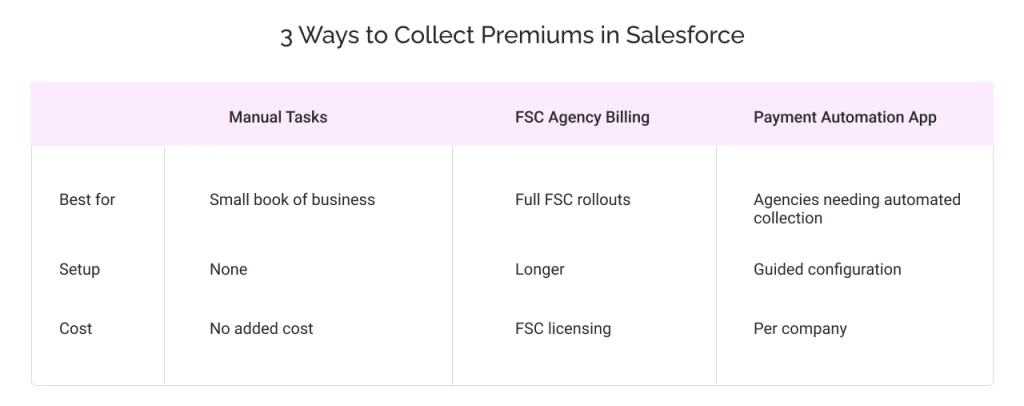
Insurance teams generally take one of three paths when moving insurance premium collection into Salesforce. Each comes with different costs, insurance-specific depth, and new features.
Manual Tasks and Reminders
Without an add-on, agents typically log premium due dates as Salesforce Tasks or Activities and manually create reminders to call, email, or text a policyholder before a payment is due.
- Uses standard Salesforce objects already available on any edition, so there’s no added licensing cost.
- It requires an agent to manually create, track, and act on each reminder individually, since Salesforce doesn’t trigger these on its own without extra automation.
- It doesn’t process the actual payment, and agents still direct policyholders to a separate payment portal or take payment details manually.
- Agents at insurance agencies report spending 15+ hours a week manually calling, texting, and emailing clients about overdue premiums, time pulled directly from selling and renewals.
Where This Works, and Where It Falls Short
This works for a single agent or a small book of business, where reminders are few enough to track manually.
It falls short once policy volume grows, since forgetting a payment date is consistently cited as one of the most common reasons policyholders miss a premium.
Financial Services Cloud’s Built-In Billing Tools
Salesforce’s Financial Services Cloud for Insurance Brokerages includes a native Agency Billing module built for insurance premium collection.
- It generates invoices automatically using customizable templates, adjusting for credit and debit memos as needed.
- It runs automated payments to collect funds and settle open invoices, using native or third-party payment gateways, turning collections into a background process.
- You can track collections and post transactions automatically to a general ledger.
- Policy Administration starts at $75,000 per $10 million in gross written premium, with a base of Financial Services Cloud licensing.
Where This Works, and Where It Falls Short
This offers the deepest native integration available inside Salesforce, since billing, collections, and ledger tracking all live in one system. It costs more and takes longer to set up, making it a better fit for insurers already committed to a full Financial Services Cloud rollout than for smaller agencies.
Dedicated Payment Automation Apps
A better alternative is to install a dedicated payment automation app directly from AgentExchange, without requiring a full Financial Services Cloud commitment.
- You can install it as a standalone app on whatever Salesforce edition an agency already runs: Sales Cloud, Service Cloud, or Financial Services Cloud
- It automates the reminder and collection cycle specifically, sending payment requests and processing the transaction inside Salesforce, rather than just logging a task to follow up manually
- It sets up through guided configuration, avoiding the extended implementation timelines a full FSC billing rollout requires
- Priced per company rather than per gross written premium, making costs more predictable for small and mid-sized agencies
Where This Works, and Where It Falls Short
This fits agencies that specifically need automated premium collection without a full policy administration rebuild. It falls short only if an agency needs deeper policy lifecycle management, quoting, underwriting, claims, beyond payments themselves, in which case Financial Services Cloud remains the more complete platform.
For most agencies, the third option offers the most direct way to fix manual premium follow-ups without disrupting an existing Salesforce setup. The next section looks at how a tool like ChargeOn handles this in practice.
How Does ChargeOn Automate Insurance Premium Payment Processing in Salesforce?
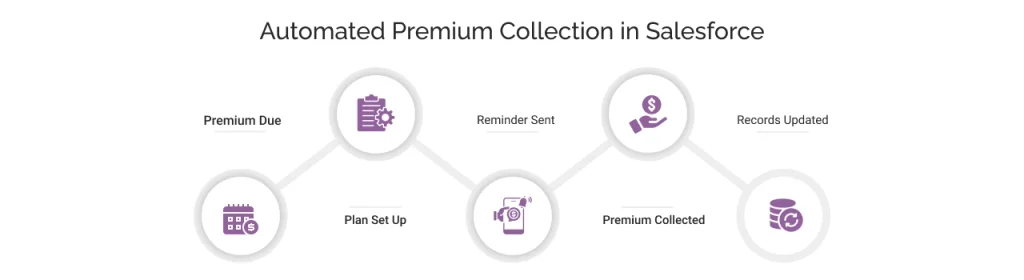
ChargeOn addresses the gap identified in the previous section: automating the actual collection cycle inside a Salesforce Org instead of sending reminders to complete it manually. Insurance premium payment processing evaluates this route, and here’s how it maps directly onto insurance premium collection.
| Manual Follow-Up Problem | How ChargeOn Handles It |
| Agents manually track who owes a premium and when | Recurring and scheduled payment setup collects premiums automatically on a defined cycle, monthly, quarterly, or annually, without a person initiating each charge. |
| Policyholders forget payment dates | Agentforce-powered payment actions let teams trigger reminders and process payments through natural language, without switching between systems to check status. |
| Payments fail silently, with no backup collection attempt | A Payment Gateway Fallback Mechanism automatically reroutes a failed transaction to a backup gateway, reducing the number of payments that fail due to a single processor issue. |
| Policyholders pay through different channels, some digital, some traditional | Supports both online (card, ACH) and offline (cash, check, bank wire) payment types, so agencies aren’t forced to push every policyholder onto one payment method. |
| Agents lack visibility into payment status without checking a separate system | Generates an invoice automatically for every payment and centralizes visibility into both offline and online transactions directly in Salesforce. |
| Multi-region books of business complicate currency handling | Offers multi-currency support with automatic formatting, relevant for agencies managing policies across regions. |
This turns premium collection from a manual task that someone has to remember to do into a process that runs on its own, with a fallback built in for when a single payment attempt doesn’t go through. For agencies already using Salesforce in insurance workflows, this installs as an AgentExchange app.
The next section covers what this shift in approach actually delivers, in terms of measurable benefits.
Key Benefits of Automating Premium Collection
Shifting the collection process from manual follow-ups to automated results in visible gains across your daily operations.
Fewer policy lapses: automated reminders and recurring collection reduce the number of missed payments, which is one of the most common reasons a policy lapses.
Reclaimed agent time: hours previously spent calling and emailing policyholders go back into selling and renewals.
Fewer failed transactions: automatic fallback to a backup gateway continues payments that would otherwise fail directly and require manual reprocessing.
Better persistency: giving policyholders more ways to pay, including cards, ACH, and digital wallets, makes it easier for them to stay current.
Real-time payment visibility: agents see payment status directly in Salesforce records, without checking a separate billing system.
Lower operational overhead: reduces the manual data entry and reconciliation work tied to tracking payments across multiple channels.
For recurring insurance premium payments, these benefits grow over time, reducing the time spent on manual tracking and speeding business growth. This is the main reason behind treating insurance premium collection as an automation problem rather than a staffing one. Because it’s Insurance premium payment processing built specifically for payments, not just CRM record-keeping, make the difference.
ChargeOn addresses this directly inside Salesforce, automating the collection cycle without requiring agencies to rebuild their existing setup. For agencies still relying on manual tracking, this is one of the more direct ways to close that gap.