

TOC
Table of Contents
Selling services or products across borders on Salesforce means collecting payments in more than one currency, without adding friction to the buying process. A growing set of Salesforce payment apps now handles this directly inside the platform, so international customers can pay in their preferred currency, and your finance teams still see clean, reconciled records.
Choosing the right app matters, since currency coverage, payment gateway support, and native integration vary widely between options. This guide breaks down what to evaluate and compares the leading Salesforce apps built for multicurrency payment collection.
What to look for in a Salesforce multicurrency payment app?
Before comparing individual apps, consider the following factors that separate an advanced multicurrency setup from a limited one.
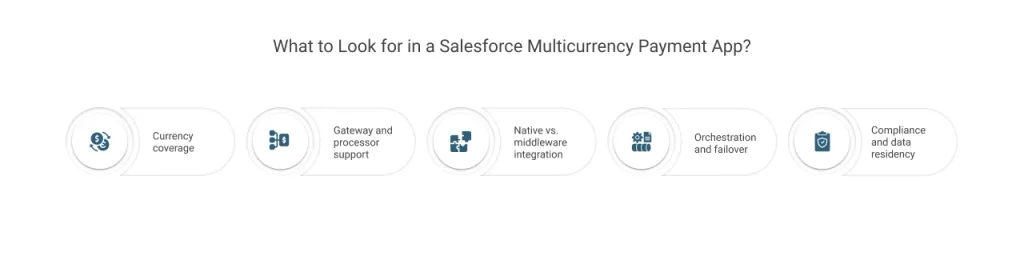
- Currency coverage: The number of currencies an app supports directly limits which markets a business can sell into without a workaround.
- Gateway and processor support: More supported gateways means more flexibility to route payments through the provider each region trusts.
- Native vs. middleware integration: A Salesforce native payment app runs inside Salesforce directly, while middleware options route data through an external layer, adding latency and points of failure.
- Orchestration and failover: Some apps only process payments, while others also manage routing logic across multiple gateways, which matters for reliability at scale.
- Compliance and data residency: International payment collection often involves regional compliance requirements, so an app’s certifications matter as much as its feature list.
We use these factors as benchmarks to assess and compare each app below.
Top Salesforce apps for multicurrency payment collection
Here is the list of best Salesforce apps for international payments:
ChargeOn
ChargeOn is a 100% Salesforce-native payment processing and orchestration platform built to sit between Salesforce and the connected payment gateway, coordinating transactions rather than moving money itself.
Because it runs natively, businesses eliminate latency and extra maintenance that middleware layers introduce.
ChargeOn connects with 19+ payment gateways, giving businesses flexibility to route currencies through whichever provider fits a given region, all configured without writing custom code.
It supports multicurrency payment collection alongside a broader feature set of 50+ capabilities, including tokenization and automated gateway fallback across up to three backup gateways
FinDock
FinDock is a Salesforce-native payment app originally built for nonprofits and subscription-based organizations, with multicurrency support available through its connected network of payment service providers (PSPs).
It handles recurring billing, donation processing, and reconciliation directly inside Salesforce, making it a strong fit for organizations managing donor or subscriber payments across regions.
FinDock’s currency coverage depends on which PSP a business connects to, rather than offering universal currency support out of the box. It integrates closely with Salesforce Nonprofit Cloud and Salesforce Billing, which makes it a common choice for mission-driven organizations operating internationally.
Unaric Payments (formerly Asperato)
Unaric Payments, previously known as Asperato, positions itself as a payment orchestration layer for Salesforce. This orchestration approach gives businesses flexibility to route international transactions through whichever provider offers the best rates or coverage in a given market.
Unaric is particularly established across European markets, where regional banking preferences shape how customers expect to pay. iDEAL in the Netherlands, Bancontact in Belgium, and SEPA Direct Debit across the Eurozone are all examples of local payment norms that a single global processor often can’t cover on its own. Unaric’s approach works well for businesses already juggling several regional processors, since it brings them together instead of replacing them.
Its multicurrency reach depends entirely on which providers a business connects, rather than a fixed currency list of its own.
Salesforce Payments
Salesforce Payments is Salesforce’s own native payment processing product, built directly into the platform without requiring a third-party connector. It handles core payment collection functions within Salesforce Commerce Cloud and other Salesforce clouds, giving businesses a first-party option maintained directly by Salesforce.
Multicurrency support is tied to Salesforce’s own processing infrastructure, which means currency coverage is limited to the markets Salesforce Payments has rolled out to directly.
Dynamic Currency Conversion is not part of the product, so businesses selling into currencies outside its supported list need a separate solution to fill that gap.
GoCardless for Salesforce Billing
GoCardless for Salesforce Billing focuses on recurring payments collected through direct debit and bank-to-bank transfer networks, rather than card-based multicurrency checkout. It integrates with Salesforce Billing to automate recurring invoicing and collection across supported regional bank networks, including BACS, SEPA, and ACH.
Its multicurrency reach is tied directly to those specific bank networks, which means coverage stops at the currencies those networks support. Businesses needing broad, card-based multicurrency collection, or Dynamic Currency Conversion at checkout, fall outside what GoCardless is built to handle.
Chargent
Chargent, built by AppFrontier, supports a wide range of currencies across multiple payment gateways.
Chargent handles one-time and recurring payments directly within Salesforce records, without requiring customers to leave the platform. Its long track record and wide gateway support make it a common default choice for businesses that need broad international currency coverage.
Blackthorn Payments
Blackthorn Payments is a Salesforce-native app built with deep integration into Stripe, supporting multiple currencies and over different payment gateways. It is designed for businesses that want payment collection embedded directly into Salesforce workflows, including event registration, billing, and donation use cases.
Blackthorn’s close Stripe integration makes it the first choice for businesses using Stripe as a primary processor. Its broader gateway network extends that flexibility further for businesses needing regional alternatives.
Now, you understand the options you have, but choosing the right one is still a tough job. The next section will help you choose the best options for your business needs.
How to choose the right app for your business?
The right choice depends on how a business actually handles currency today, and where the gaps are. A few multicurrency-specific questions help narrow the decision.
- How many currencies do we need to support right now, versus in the next few years?
An app’s currency count should match the business’s target markets, not just only current ones.
- Do we need Dynamic Currency Conversion at checkout, or is settling in one currency enough?
Yes, it is required for global businesses. Some apps convert automatically at the point of sale while others leave conversion to the connected gateway or bank.
- Are we tied to one processor’s currency list, or do we need multi-provider flexibility?
A single gateway relationship can restrict currency reach, an orchestration layer removes that.
- Is our multicurrency need card-based, bank-based, or both?
Some apps handle broad card currencies well but are limited on bank-based collection, and vice versa.
- How much manual currency conversion work happens today that should be automated?
Manual reconciliation across currencies is a sign the current setup wasn’t built for multicurrency at scale. Therefore, you should go for an automated solution.
Matching these questions to actual business priorities, rather than picking based on overall feature count, leads to a multicurrency setup that holds up as new markets come online.

Conclusion
Every business selling internationally on Salesforce reaches the same question eventually: which app should handle payment collection across currencies? The right answer depends less on the number of features and more on business priorities. This evaluation will help you choose the best multicurrency payment app for your business.